

Explore our new Cybersecurity Terms Glossary, explained by our experts.

Explore our new Cybersecurity Terms Glossary, explained by our experts.
Cybersecurity Terms Glossary
A distributed control system is the integrated control platform that runs a continuous process plant, placing controllers close to the process and co-ordinating them through a common engineering and operator environment.
What Is a Distributed Control System?
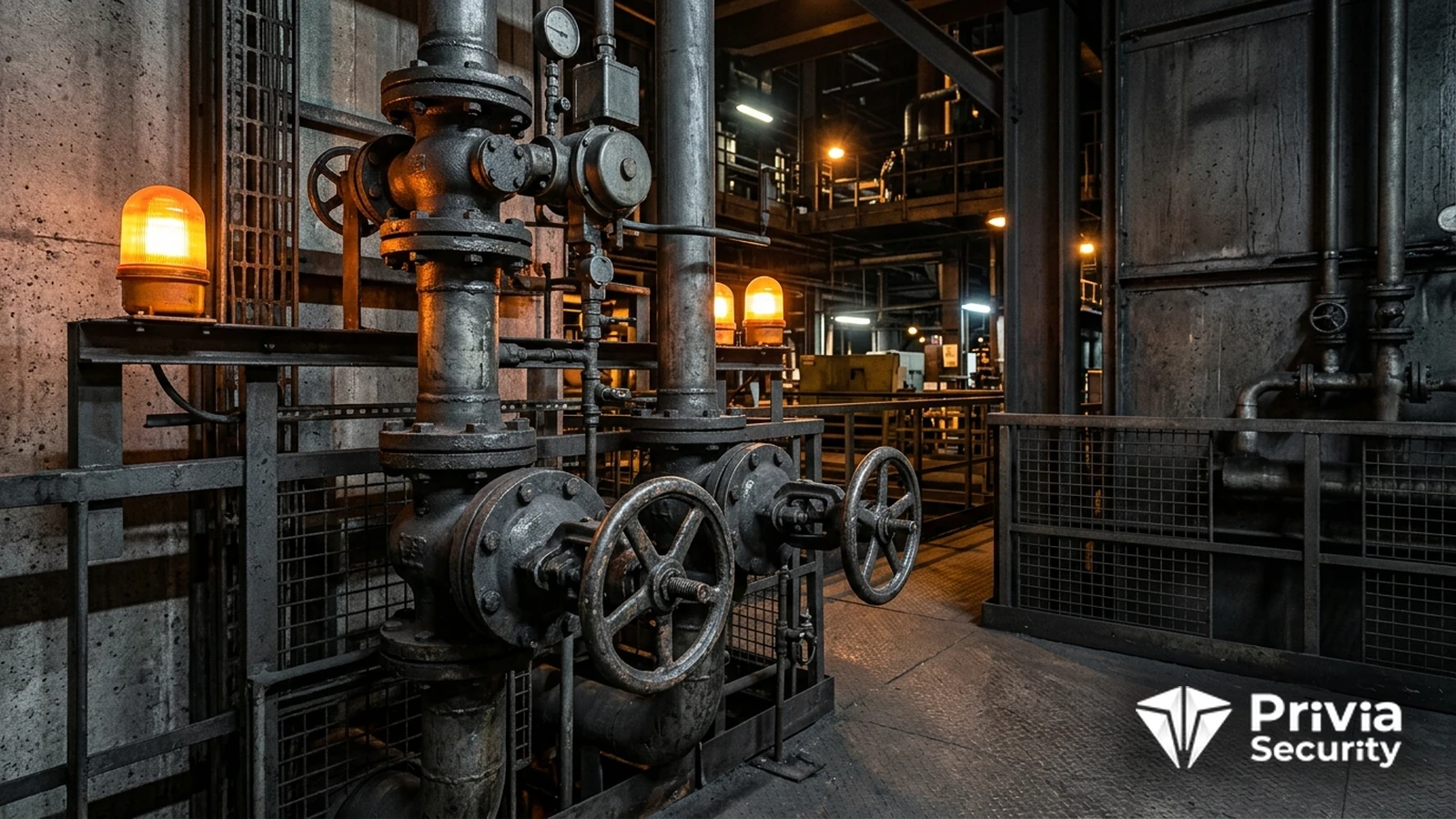
A distributed control system is what runs a refinery, a chemical plant, a paper mill, a pharmaceutical reactor hall, or the balance of plant in a power station. The word distributed describes the architecture rather than the geography: control is executed by multiple controllers placed near the equipment they regulate, each closing its own loops in milliseconds, while a common engineering database, operator environment, and alarm system tie them into a single plant-wide system.
The major platforms are familiar to anyone who has worked in process industries: Honeywell Experion, Emerson DeltaV, ABB 800xA, Yokogawa Centum, Siemens PCS 7, and the Foxboro line from Schneider Electric. They are sold as integrated systems rather than as components, which has consequences for how they are secured.
The two terms are used interchangeably and should not be. A SCADA system supervises assets spread over distance, polling remote sites over slow or intermittent links and accepting that the picture is seconds old; control decisions mostly happen locally at the outstation. A DCS controls a single plant over a fast, reliable, usually redundant network, executes the control strategy itself on a deterministic cycle, and is engineered as one coherent database from field signal to operator graphic.
That difference shapes the risk. A SCADA attacker needs to reach one remote site. A DCS attacker who reaches the control network reaches the whole plant, because the system is designed as a single trust domain.
Four characteristics recur across assessments. First, the operating systems underneath are supported on the vendor’s schedule, not Microsoft’s, so a plant may run versions that lost mainstream support years ago because the DCS release validated against anything newer requires a shutdown to install. Second, antivirus and endpoint tooling run with broad exclusions mandated by the vendor, which attackers can simply live inside. Third, the control network is often flat: segmentation within the plant is rare, because the system was engineered as one entity. Fourth, remote access for vendor support and for advanced applications is pervasive, and the accounts are shared.
Add to that the engineering reality that control logic changes go through a management of change process measured in weeks, and you have an environment where conventional IT security practice does not transplant. It must be redesigned, which is what IEC 62443 exists to describe.
At Privia Security, we assess process control architectures and their boundaries through our OT-SCADA Penetration Test.
A PLC is a controller; a DCS is an integrated system of controllers, operator stations, engineering tools, and a common configuration database sold and supported together. PLC-based systems are typically assembled from components by an integrator and suit discrete machinery, while a DCS suits continuous and batch processes where plant-wide control strategy, alarm management, and operator graphics must be engineered coherently.
Not on the same schedule. Operating system and application updates must be validated by the vendor against the installed DCS version, and installation usually needs a process outage. Mature operators run a validated patch stream batched into planned shutdowns, with compensating controls such as allow-listing, segmentation, and monitoring covering the interval in between.
Integrated engineering is convenient and common, but the safety instrumented system should sit in its own security zone with a tightly controlled conduit, its own accounts, and physical key switch protection against programming changes. The Triton malware in 2017 reached a safety controller through exactly this path, which is why the separation is now treated as a design requirement rather than a preference.
Controller logic and configuration, operator graphics, alarm and interlock configuration, the engineering project database, historian data and its configuration, and the licence and installation media for the exact versions in use. Store copies offline, test a restore on spare hardware, and record the vendor support contacts needed for a rebuild, because you will not be downloading anything mid-incident.
You May Be Interested In These

We use a few cookies that are needed to make this website work, and they are always on. We would also like to set analytics cookies, to see which pages are useful; functional cookies, so that our live chat works; and advertising cookies, to measure our campaigns. We will not set any of those until you say yes, and you can change your mind at any time from the Cookie Settings link in the footer.
Choose the cookies you are happy for us to use. Strictly necessary cookies are always on; everything else is off until you turn it on.
These cookies keep the website working: they hold your security checks, your form submissions and the choice you make here. The site cannot run without them, so they are always on.
These let our live chat open and remember your conversation, and let the newsletter sign-up work. Switch them off and the chat window will not appear.
These tell us which pages are read and how people find us, so that we can improve the site. The reports are about groups of visitors, never about you personally.
These let us measure our advertising and show you our adverts on other websites, such as LinkedIn, Google and Meta. Switch them off and you will still see adverts, but they will be less relevant.


