

Explore our new Cybersecurity Terms Glossary, explained by our experts.

Explore our new Cybersecurity Terms Glossary, explained by our experts.
Cybersecurity Terms Glossary
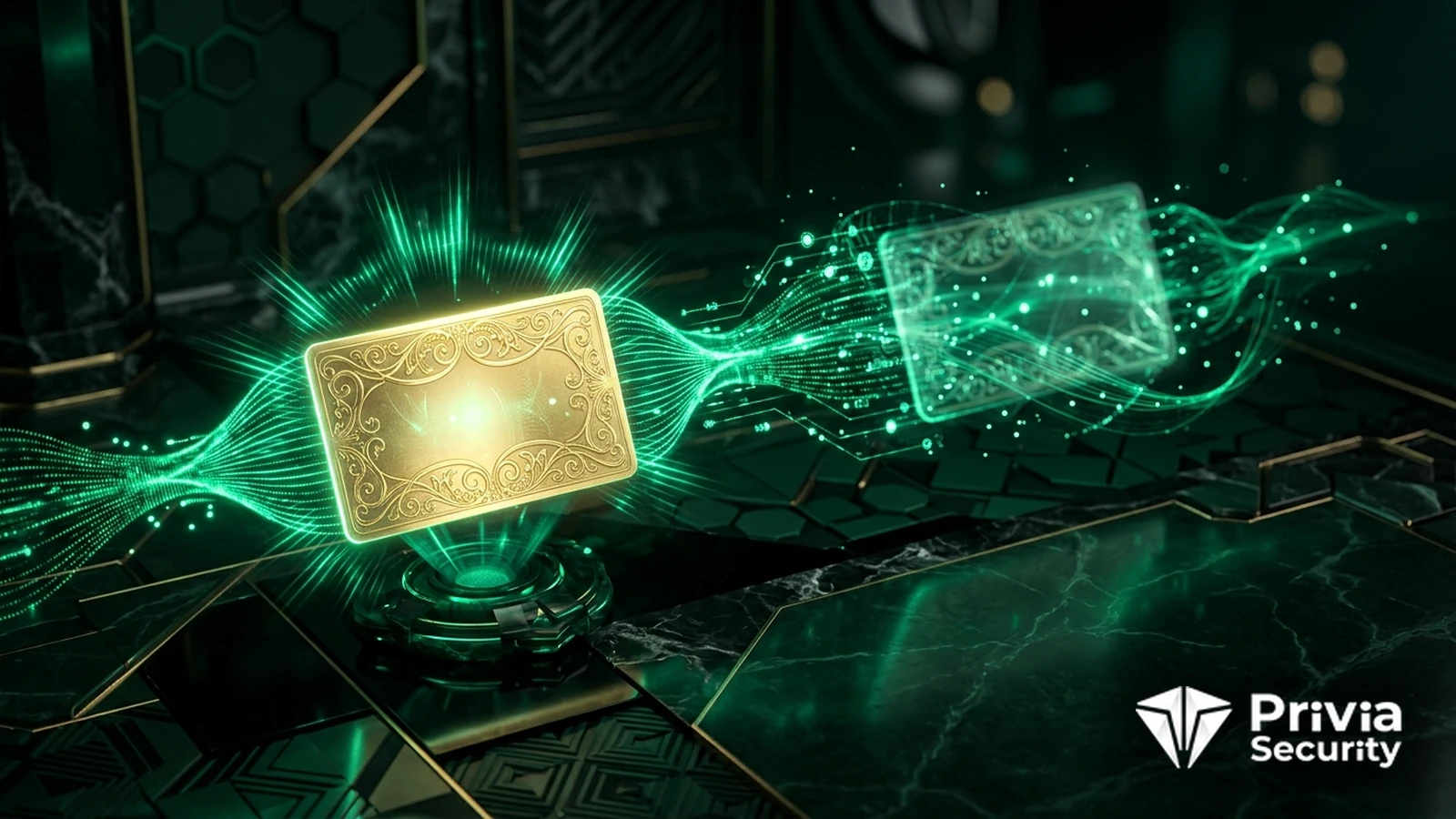
Access card cloning is the copying of the identifier held on a staff access card onto a blank card, producing a duplicate that the door controller accepts as genuine.
What Is Access Card Cloning?
Most buildings run on a credential designed for convenience rather than security. A card is presented to a reader, the reader passes a number to the controller, the controller checks that number against an allowed list, and the door releases. Access card cloning is the act of reading that number from a legitimate card and writing it to a blank one, so that the access control system cannot tell the copy from the original.
It is one of the first things a physical security assessment tests, because it converts a few seconds of proximity to an employee into persistent, repeatable entry.
The 125 kHz proximity cards still common in UK offices, such as HID ProxCard II and EM4100 derivatives, broadcast a fixed facility code and card number whenever they enter a reader’s field. There is no challenge, no response, and no cryptography. A handheld duplicator sold online for the price of a takeaway copies one in seconds, and tools such as the Proxmark3 or a Flipper Zero add capture, replay, and brute-force options on top.
Range is the part that surprises people. Long-range readers of the kind demonstrated as the Tastic RFID Thief can be built into a clipboard or a rucksack and will lift a credential through a jacket pocket from the better part of a metre. The cardholder feels nothing and notices nothing, because the original card still works.
The 13.56 MHz generation was meant to fix this. MIFARE Classic, launched in the mid-1990s and still widely deployed, relies on the proprietary Crypto-1 cipher that researchers reverse engineered and broke in 2008. Offline tools recover the sector keys from a captured card in minutes, after which the card can be read, modified, and emulated at will. A reader that still accepts the card serial number alone is no better than a 125 kHz system.
Physical access is network access. A tester inside a comms cupboard can connect a drop box to a spare patch port, pull a laptop from a desk, photograph a whiteboard, or plug a device into a printer. Just as valuable is the social effect: someone wearing a plausible badge is challenged far less often, which makes every subsequent pretext easier. This is the point at which physical and digital risk stop being separate subjects, as covered in physical-cyber convergence.
The durable fix is the credential itself. Modern cryptographic credentials such as MIFARE DESFire EV3, HID Seos, and mobile credentials in a phone wallet perform mutual authentication with diversified keys, so a captured exchange cannot be replayed and a card cannot be read out. Migration is a budgeted programme rather than a quick change, because readers, controllers, and the enrolment process all move together.
Alongside it, several controls raise the cost of a clone considerably:
Physical credential testing is carried out under written authorisation that names the sites, the dates, the techniques permitted, and a point of contact who can vouch for the team if security staff intervene. NPSA guidance on personnel and physical security sits alongside the technical controls, and the reporting should tell you which doors were reached, how far a cloned badge travelled, and which detection opportunities were missed. At Privia Security, badge cloning and building entry are part of the scenarios we run in our Red Team Services.
For an unencrypted 125 kHz proximity card, a few seconds of contact and a few seconds of writing. For a MIFARE Classic card, key recovery usually takes minutes with freely available tools once the card has been read. Properly configured DESFire or Seos credentials cannot be cloned this way at all, because the reader and card authenticate each other with diversified keys.
Yes. Long-range readers concealed in a bag or clipboard can energise a 125 kHz card and capture its identifier from several tens of centimetres, which is close enough on a busy train or in a lift queue. The cardholder notices nothing because the original card continues to work normally. Shielded wallets reduce the exposure for low-frequency cards.
It helps only if people look. A printed photo raises the effort of a visual forgery and supports a challenge culture, but it does nothing to stop the radio exchange being copied. Treat the printed design as a deterrent layer and the cryptographic credential as the control, and train staff that a badge on a lanyard is not by itself evidence of authorisation.
Readers, writers, and blank cards are ordinary equipment, but using them against a building you do not own requires written permission from someone able to grant it. A scope document naming the sites, dates, techniques, and an out-of-hours contact protects the tester and the client. Responsible teams carry that letter physically and expect to be stopped and checked.
You May Be Interested In These

We use a few cookies that are needed to make this website work, and they are always on. We would also like to set analytics cookies, to see which pages are useful; functional cookies, so that our live chat works; and advertising cookies, to measure our campaigns. We will not set any of those until you say yes, and you can change your mind at any time from the Cookie Settings link in the footer.
Choose the cookies you are happy for us to use. Strictly necessary cookies are always on; everything else is off until you turn it on.
These cookies keep the website working: they hold your security checks, your form submissions and the choice you make here. The site cannot run without them, so they are always on.
These let our live chat open and remember your conversation, and let the newsletter sign-up work. Switch them off and the chat window will not appear.
These tell us which pages are read and how people find us, so that we can improve the site. The reports are about groups of visitors, never about you personally.
These let us measure our advertising and show you our adverts on other websites, such as LinkedIn, Google and Meta. Switch them off and you will still see adverts, but they will be less relevant.


