

Explore our new Cybersecurity Terms Glossary, explained by our experts.

Explore our new Cybersecurity Terms Glossary, explained by our experts.
Cybersecurity Terms Glossary
Raw, E01, Ex01, AFF4 and the logical container formats each store a forensic copy differently, trading portability against compression, embedded case metadata, and built-in integrity checking.
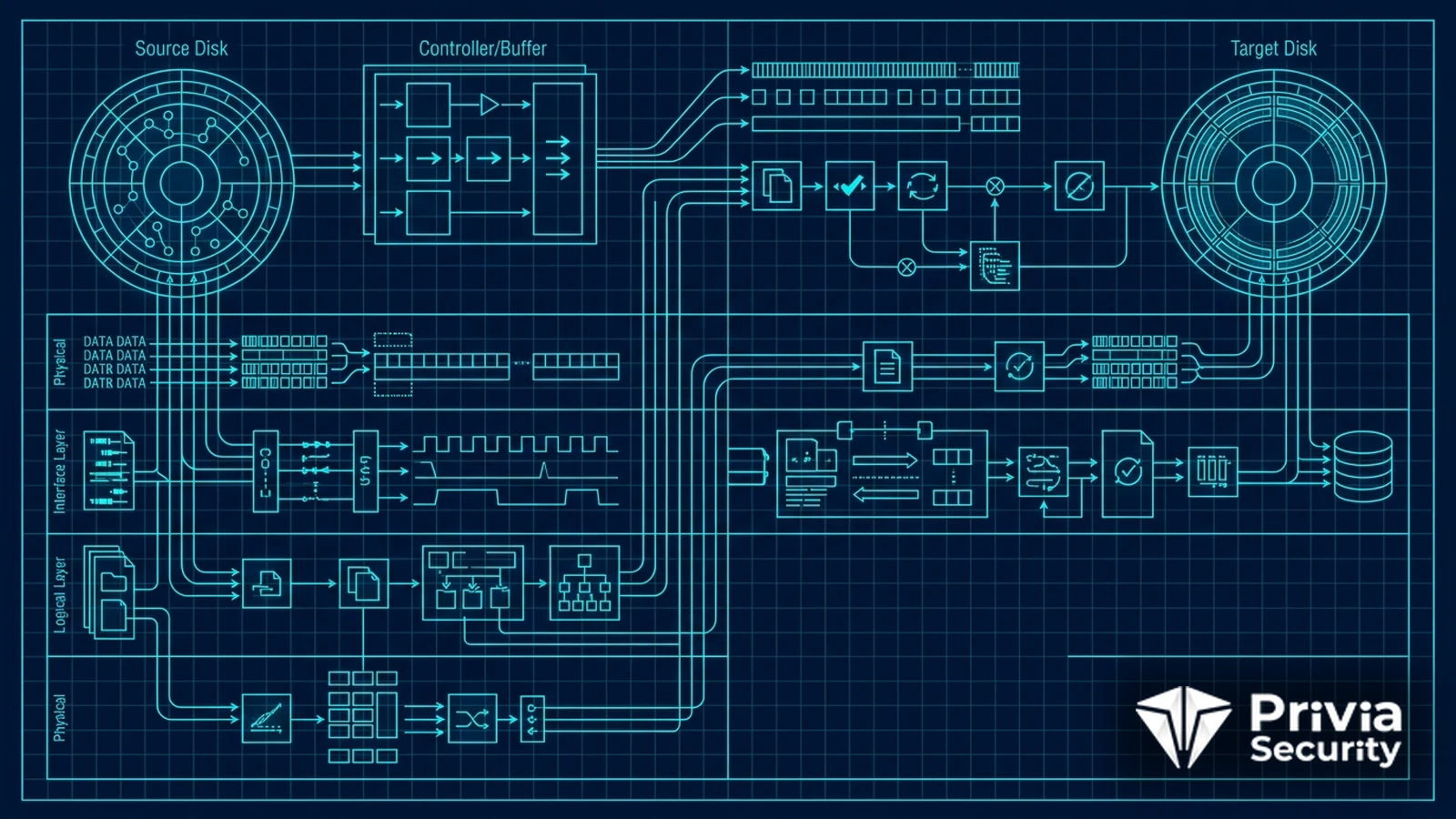
What Are Forensic Image Formats?
Once a disk has been acquired, the bytes have to live somewhere. The container you choose determines whether the image compresses, whether it carries its own integrity checks, whether another laboratory can open it in ten years, and how much contextual information travels with it. The choice looks administrative and turns out to matter.
A raw image, often called a dd image after the tool that popularised it, is an exact sequence of the source bytes with nothing added. It is readable by every forensic tool in existence, mounts directly on Linux, and will still open decades from now because there is no format to become obsolete. The costs are equally plain: no compression, so an 8 TB disk needs 8 TB of storage even if it is mostly empty, and no internal integrity protection, so the hash is recorded separately in your notes and a single flipped bit is undetectable until verification fails on the whole file.
Raw images are frequently split into fixed-size segments with extensions such as .001 and .002, originally to fit FAT32 limits and still useful for transport.
The Expert Witness Format, introduced with EnCase and usually seen as .E01, is the default in most laboratories. It compresses, which commonly halves or better the storage needed for a sparsely used disk. It embeds case metadata — examiner name, case number, evidence number, acquisition notes, and timestamps — inside the file. It stores an MD5 or SHA-1 of the acquired data in the image itself, and it adds a CRC to each data chunk, so corruption is localised and detectable rather than catastrophic. Large acquisitions are split into numbered segments that the tool reassembles transparently.
Ex01, from EnCase 7 onwards, adds stronger compression and optional AES-256 encryption of the image, which is genuinely useful when evidence has to travel. The open-source libewf project reads and writes both, giving ewfacquire, ewfverify, and ewfmount for teams that do not want a commercial dependency in their chain.
The Advanced Forensic Format was designed as an open alternative with extensible metadata. Its successor AFF4 went further, treating an image as a set of addressable data streams rather than a single blob, which makes it efficient for sparse acquisitions, memory captures, and logical collections. AFF4 is used by Velociraptor and several memory acquisition tools, and AFF4-L handles logical collections of selected files. Tool support is narrower than for EWF, so check what your analysis platform will ingest before standardising on it.
Where you are preserving selected files rather than a whole device — a mailbox export, a set of server directories, a cloud download — logical containers such as L01, Lx01, and AD1 keep the files together with their metadata and hashes. Virtual machine formats including VMDK and VHDX appear constantly in cloud and virtualised investigations, and most forensic tools now read them natively, which is often simpler than converting to raw first.
Whatever you choose, verify after acquisition and again before analysis, record the hash in the chain of custody, and note the tool and version — see disk imaging and write blockers for the acquisition side. Our digital forensics services deliver images in whichever format the receiving party can verify, which in cross-border matters is rarely a given.
For most work, yes. It compresses, embeds case metadata, stores the acquisition hash inside the file, and adds per-chunk checksums so corruption is localised and detectable. Raw images win on universal compatibility and long-term format independence, which is why some archives keep raw copies. The deciding factors are usually storage cost and what the receiving laboratory can open.
Yes. Compression in E01, Ex01 and AFF4 is lossless and applies to the container, not the data. Extracting the image returns a byte-identical copy of the source, which is why the hash of the acquired data stored inside the file still verifies. Confirm it by running the verification function of your tool after acquisition and recording the result.
A physical image copies every sector of the device, including unallocated space, slack, and deleted content. A logical image preserves only selected files and their metadata. Physical images support carving and deleted file recovery; logical ones are smaller, faster, and often the proportionate choice when scope has been agreed to avoid collecting unrelated personal data.
SHA-256 as the primary value. MD5 remains common in older tools and reports and is still useful for cross-checking against legacy records, so compute both where the tool allows it at no extra cost. Record the values in the acquisition notes and the chain of custody rather than relying solely on what is embedded in the image file.
You May Be Interested In These

We use a few cookies that are needed to make this website work, and they are always on. We would also like to set analytics cookies, to see which pages are useful; functional cookies, so that our live chat works; and advertising cookies, to measure our campaigns. We will not set any of those until you say yes, and you can change your mind at any time from the Cookie Settings link in the footer.
Choose the cookies you are happy for us to use. Strictly necessary cookies are always on; everything else is off until you turn it on.
These cookies keep the website working: they hold your security checks, your form submissions and the choice you make here. The site cannot run without them, so they are always on.
These let our live chat open and remember your conversation, and let the newsletter sign-up work. Switch them off and the chat window will not appear.
These tell us which pages are read and how people find us, so that we can improve the site. The reports are about groups of visitors, never about you personally.
These let us measure our advertising and show you our adverts on other websites, such as LinkedIn, Google and Meta. Switch them off and you will still see adverts, but they will be less relevant.


