

Explore our new Cybersecurity Terms Glossary, explained by our experts.

Explore our new Cybersecurity Terms Glossary, explained by our experts.
Cybersecurity Terms Glossary
Hydroelectric control system security protects the governors, gate controllers, protection relays, and SCADA that run dams and hydro stations, where a failure is a safety event as well as an outage.
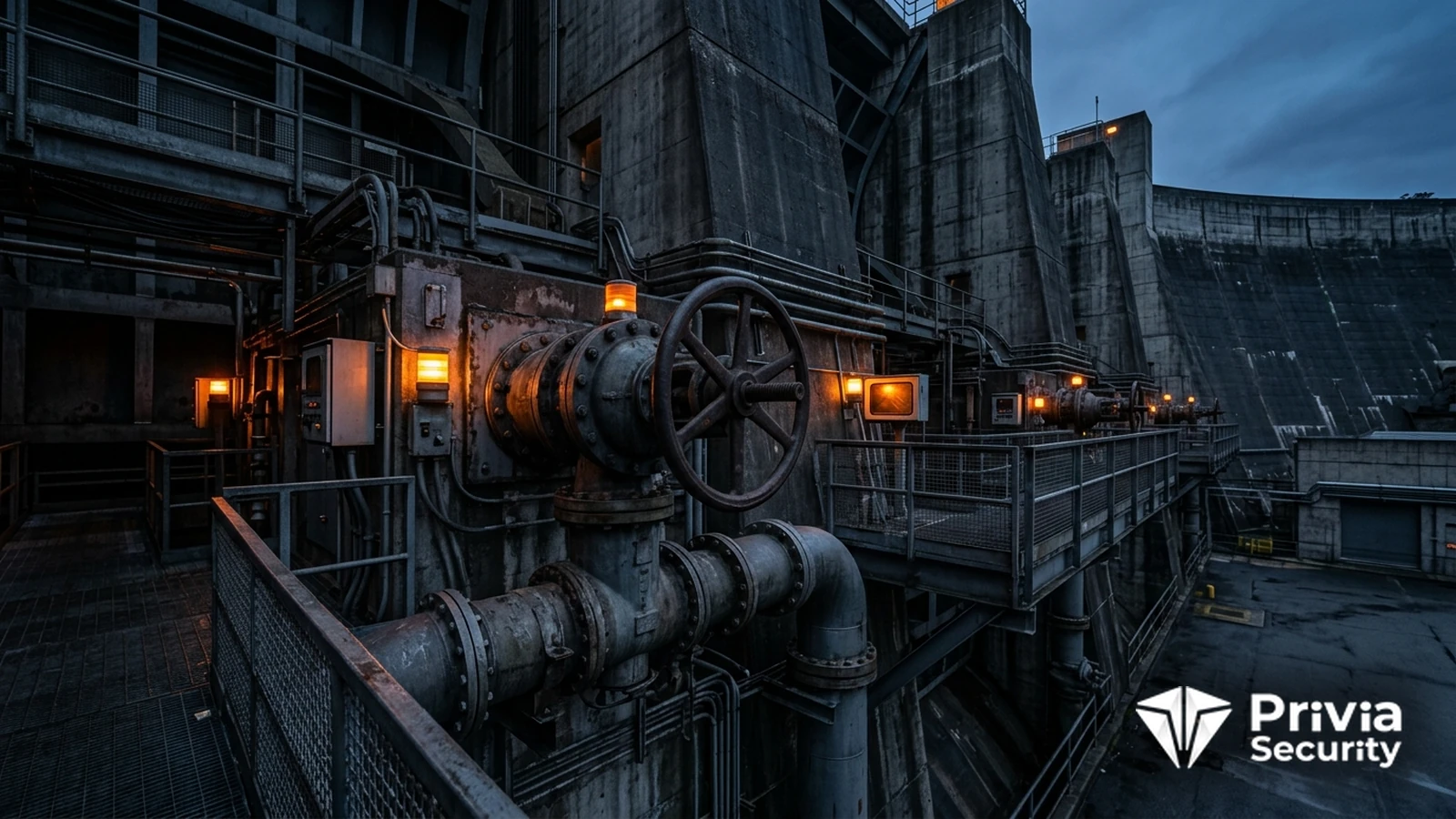
What Is Hydroelectric Control System Security?
A hydroelectric station is a control problem long before it is an IT problem. Water level, gate position, turbine speed, and grid frequency all have to stay inside narrow limits, and the equipment holding them there is a mixture of programmable logic controllers, turbine governors, protection relays, and a SCADA layer that often supervises a whole fleet of plants from one control centre. Hydroelectric control system security is the discipline of protecting that chain so that neither an attacker nor an unreviewed change can move water or power in a way the operator did not intend.
What separates hydro from other generation is the consequence. A compromised breaker costs megawatt hours; a compromised spillway gate is a public safety matter for everyone downstream, which is why dam operators increasingly treat control system security and dam safety engineering as one subject rather than two.
Most stations share the same building blocks, whether they run a 2 MW run-of-river scheme or a pumped storage plant:
The risk profile is driven by geography and age as much as by software:
The best-known case remains the Bowman Avenue Dam in Rye Brook, New York, where an attacker reached the supervisory system of a small flood control dam in 2013; the US Department of Justice indicted seven Iranian nationals over the intrusion in March 2016, noting that a sluice gate was fortunately disconnected for maintenance at the time. Industroyer2, found in a Ukrainian energy operator in April 2022, showed that purpose-built malware can speak IEC 60870-5-104 directly to generation and transmission equipment. In November 2023 the CyberAv3ngers group defaced internet-exposed Unitronics Vision PLCs at water utilities, including the Municipal Water Authority of Aliquippa in Pennsylvania, simply by reaching devices that still used the vendor default password. The same controller families appear in small hydro schemes.
British hydro operators, from the pumped storage plants at Dinorwig and Cruachan to run-of-river schemes in Scotland and Wales, generally sit inside two regimes at once. Electricity generators above the capacity thresholds are operators of essential services under the Network and Information Systems Regulations 2018, assessed by Ofgem against the NCSC Cyber Assessment Framework. Separately, large raised reservoirs are governed by the Reservoirs Act 1975, which places duties on undertakers and supervising engineers for structural safety. The two regimes are rarely joined up on paper, so the operator has to join them up in practice: a cyber scenario that affects gate control is also a dam safety scenario and belongs in the on-site emergency plan.
Our OT-SCADA Penetration Test examines hydro control environments using passive analysis and agreed, carefully bounded testing that puts generation continuity and public safety first.
Only where gate movement is under remote electrical control and the controller is reachable. Many large dams keep spillway gates on local control with mechanical interlocks and operator presence, which limits the risk. Smaller flood control and run-of-river schemes are more likely to be fully remote. The honest answer comes from an engineering review of each gate, not from a general assumption.
Yes, when it is scoped for the environment. Testers work mainly from passive traffic capture, configuration and architecture review, and offline or replica equipment. Any active work on live governors or relays is agreed with plant engineers beforehand, run during an outage window, and halted the moment a process behaves unexpectedly. Coverage is traded away for safety wherever the two conflict.
It depends on installed capacity and the thresholds set for electricity generation. Many small schemes fall below them and are not designated operators of essential services. They are still exposed through the aggregator or fleet operator that supervises them, and that organisation may well be in scope, so contractual security requirements often reach the small site anyway.
Start with the boundary and the engineering path. Log and alert on every connection crossing from corporate IT or the internet into the plant network, every remote access session, and every write or programme-download command seen on industrial protocols. Those three sources catch the majority of meaningful events without requiring agents on controllers that cannot support them.
You May Be Interested In These


We use a few cookies that are needed to make this website work, and they are always on. We would also like to set analytics cookies, to see which pages are useful; functional cookies, so that our live chat works; and advertising cookies, to measure our campaigns. We will not set any of those until you say yes, and you can change your mind at any time from the Cookie Settings link in the footer.
Choose the cookies you are happy for us to use. Strictly necessary cookies are always on; everything else is off until you turn it on.
These cookies keep the website working: they hold your security checks, your form submissions and the choice you make here. The site cannot run without them, so they are always on.
These let our live chat open and remember your conversation, and let the newsletter sign-up work. Switch them off and the chat window will not appear.
These tell us which pages are read and how people find us, so that we can improve the site. The reports are about groups of visitors, never about you personally.
These let us measure our advertising and show you our adverts on other websites, such as LinkedIn, Google and Meta. Switch them off and you will still see adverts, but they will be less relevant.


