

Explore our new Cybersecurity Terms Glossary, explained by our experts.

Explore our new Cybersecurity Terms Glossary, explained by our experts.
Cybersecurity Terms Glossary
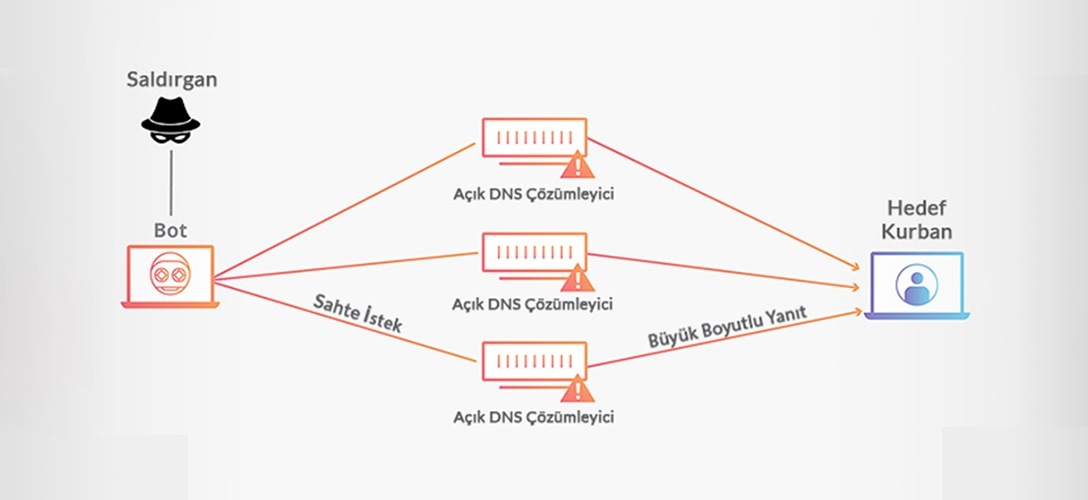
A DNS amplification attack is a reflection-based DDoS technique: small spoofed queries make open resolvers send far larger responses to a victim, saturating its connection with traffic it never requested.
What Is a DNS Amplification Attack?
A DNS amplification attack is a distributed denial-of-service technique in which an attacker sends small DNS queries with a forged source address so that much larger responses are delivered to a victim who never asked for them. The attacker contributes a trickle of traffic, the world’s name servers contribute the flood, and the target’s connection is exhausted.
It is a reflection attack as well as an amplification attack. The packets that reach the victim come from legitimate, correctly configured name servers, so blocking the apparent sources is both ineffective and harmful, and the real origin stays hidden.
The ratio between query and response is the amplification factor. The US-CERT alert TA14-017 measured DNS at roughly 28 to 54 times, and a well-chosen signed domain can exceed that. For comparison:
| Protocol | Reported amplification factor |
|---|---|
| DNS | 28–54x |
| NTP (monlist) | up to 557x |
| memcached | up to 51,000x |
Scale follows from the arithmetic. The attack on Spamhaus in March 2013 reached about 300 Gbps using open resolvers and was, at the time, the largest publicly reported DDoS attack. Other protocols have since produced larger peaks, but DNS stays attractive to attackers because UDP port 53 cannot simply be blocked at the network edge without breaking name resolution for everyone.
This is a volumetric attack, not a manipulation of DNS answers. It should not be confused with DNS cache poisoning, where the content of the response is what matters.
Three parties suffer at once. The victim loses availability. The resolver operators unwittingly send the attack traffic, burn their own bandwidth, and may end up on block lists. The transit networks in between carry the amplified volume. Many organisations discover they are running an open resolver only when an upstream provider tells them their server is participating in an attack.
Apply source address validation at every edge, as described in BCP 38 (RFC 2827), so that packets claiming a source outside your address space never leave. This is the one measure that removes the root cause rather than the symptom, and it protects everyone except yourself, which is why adoption is still incomplete.
Filtering at your own firewall achieves nothing once the upstream link is full; mitigation has to happen before the traffic reaches you. Arrange scrubbing or always-on protection with your provider in advance, agree how it is activated and who may authorise it, and rehearse that call. Anycast distribution and surplus capacity buy time while the mitigation engages.
NCSC denial-of-service guidance recommends understanding your dependencies, agreeing mitigation with your provider before you need it, and testing the response plan; its Protective DNS service is available to UK public sector organisations. Taking part in such an attack, including paying for a booter or stresser service, is an offence under the Computer Misuse Act 1990, and UK police forces have prosecuted customers of these services as well as their operators.
At Privia Security, we review DNS exposure, resolver configuration, and the resilience of internet-facing infrastructure as part of our network security services.
You May Be Interested In These



We use a few cookies that are needed to make this website work, and they are always on. We would also like to set analytics cookies, to see which pages are useful; functional cookies, so that our live chat works; and advertising cookies, to measure our campaigns. We will not set any of those until you say yes, and you can change your mind at any time from the Cookie Settings link in the footer.
Choose the cookies you are happy for us to use. Strictly necessary cookies are always on; everything else is off until you turn it on.
These cookies keep the website working: they hold your security checks, your form submissions and the choice you make here. The site cannot run without them, so they are always on.
These let our live chat open and remember your conversation, and let the newsletter sign-up work. Switch them off and the chat window will not appear.
These tell us which pages are read and how people find us, so that we can improve the site. The reports are about groups of visitors, never about you personally.
These let us measure our advertising and show you our adverts on other websites, such as LinkedIn, Google and Meta. Switch them off and you will still see adverts, but they will be less relevant.


