

Explore our new Cybersecurity Terms Glossary, explained by our experts.

Explore our new Cybersecurity Terms Glossary, explained by our experts.
Cybersecurity Terms Glossary
Zones and conduits are the IEC 62443 method for partitioning an industrial system into groups of assets with shared security requirements and controlling every communication path between them.
What Are Zones and Conduits?
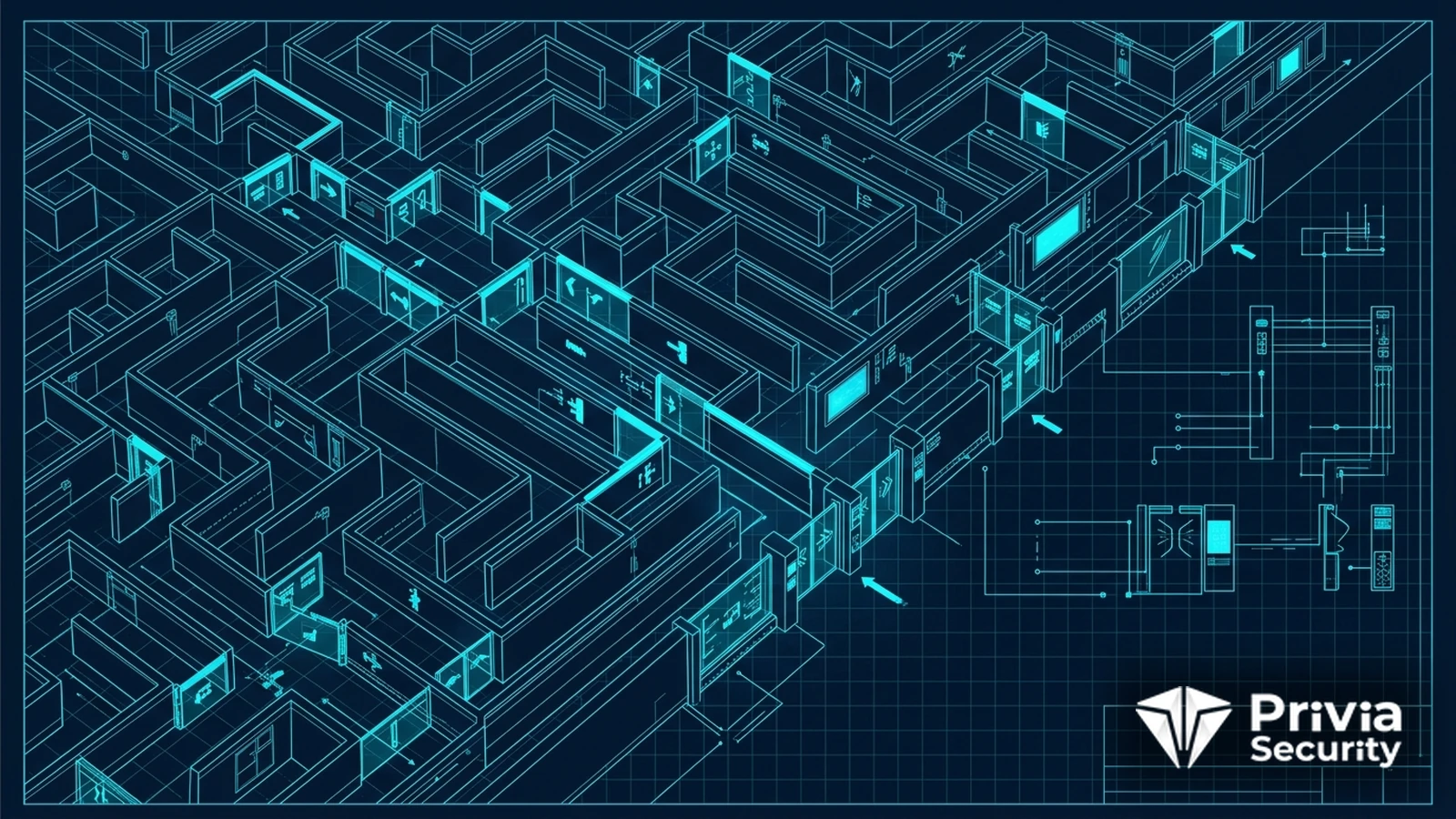
Zones and conduits are how IEC 62443 turns a plant into something that can be secured. A zone is a grouping of assets that share security requirements, usually because they share a consequence: if one is compromised, the others are effectively compromised too, so defending them individually buys nothing. A conduit is the controlled path that carries communication between zones, and it is a thing in its own right with its own security requirements, not merely a line on a drawing.
The idea sounds obvious until you try to apply it. The hard part is not drawing boxes; it is accepting what the boxes imply. If two systems are in the same zone, you are asserting that compromising one means compromising both. Most flat control networks turn out to be a single enormous zone, and stating that plainly is often the most useful output of the first workshop.
IEC 62443-3-2 sets out a sequence of zone and conduit requirements, usually followed in this order:
A worked example for a treatment plant might look like this: a safety zone containing the shutdown system; a control zone containing the PLCs and their I/O; a supervisory zone containing HMIs, the local historian, and engineering workstations; a site operations zone with the manufacturing execution and reporting systems; a demilitarised zone holding the replication broker, patch distribution, and remote access gateway; and a separate telemetry zone for remote sites. Six zones, each with a defensible reason, rather than one flat network.
Every zone boundary crossing becomes a conduit, and each conduit gets a target security level, a defined set of permitted flows, an enforcement mechanism, and a monitoring requirement. In practice that means an OT firewall or a managed switch access list enforcing the flows, and a passive sensor watching them. Conduits that must be strictly one-way, such as historian replication out of a high-consequence zone, are implemented with a unidirectional gateway rather than a rule.
Wireless links, vendor cellular routers, serial connections, and removable media routes are all conduits whether or not anyone drew them. A zone model that omits the USB stick an engineer carries between the office and the control room is describing a plant that does not exist.
The Purdue model describes function; zones describe security requirement. Purdue levels are a sensible starting point for partitioning, but two systems at the same level frequently belong in different zones, and a cloud-connected sensor may sit in a zone of its own regardless of which level it nominally occupies. Use Purdue to orient the conversation and zones to produce the enforceable design.
For UK operators of essential services, a documented zone model answers the Cyber Assessment Framework’s questions under Principle B4 directly, because both frameworks reason from consequence rather than from technology. At Privia Security, our Infrastructure and Architecture Review Services run the partitioning workshop with your engineers and then verify the boundaries against the running configuration.
Enough that each one has a distinct security requirement, and no more. A single process area commonly yields four to eight. Too few means you are asserting that unrelated systems share a fate; too many creates conduits nobody maintains and rules that get relaxed under operational pressure until the model stops reflecting reality.
No. A zone is a design concept derived from security requirements; a VLAN is one way to enforce it. A zone may span several VLANs, and a badly configured VLAN provides no enforcement at all. Define zones first from consequence, then choose the technology that enforces each conduit.
Yes. IEC 62443 treats a conduit as an entity with its own target level, which is normally at least as high as the more demanding of the zones it connects. That matters in practice because it drives decisions about authentication, encryption, inspection, and whether the path should be unidirectional.
Drawing the model on consequence and then implementing it on convenience. Architecture reviews routinely find a domain controller serving both sides of a boundary, a backup agent reaching inwards, or a remote access tool bridging the whole stack. Verify every conduit against the running configuration, not against the diagram.
You May Be Interested In These

Cybersecurity Terms
17 November 2026
What Are the Rules of Engagement in a Penetration Test?
Read More
We use a few cookies that are needed to make this website work, and they are always on. We would also like to set analytics cookies, to see which pages are useful; functional cookies, so that our live chat works; and advertising cookies, to measure our campaigns. We will not set any of those until you say yes, and you can change your mind at any time from the Cookie Settings link in the footer.
Choose the cookies you are happy for us to use. Strictly necessary cookies are always on; everything else is off until you turn it on.
These cookies keep the website working: they hold your security checks, your form submissions and the choice you make here. The site cannot run without them, so they are always on.
These let our live chat open and remember your conversation, and let the newsletter sign-up work. Switch them off and the chat window will not appear.
These tell us which pages are read and how people find us, so that we can improve the site. The reports are about groups of visitors, never about you personally.
These let us measure our advertising and show you our adverts on other websites, such as LinkedIn, Google and Meta. Switch them off and you will still see adverts, but they will be less relevant.


