

Explore our new Cybersecurity Terms Glossary, explained by our experts.

Explore our new Cybersecurity Terms Glossary, explained by our experts.
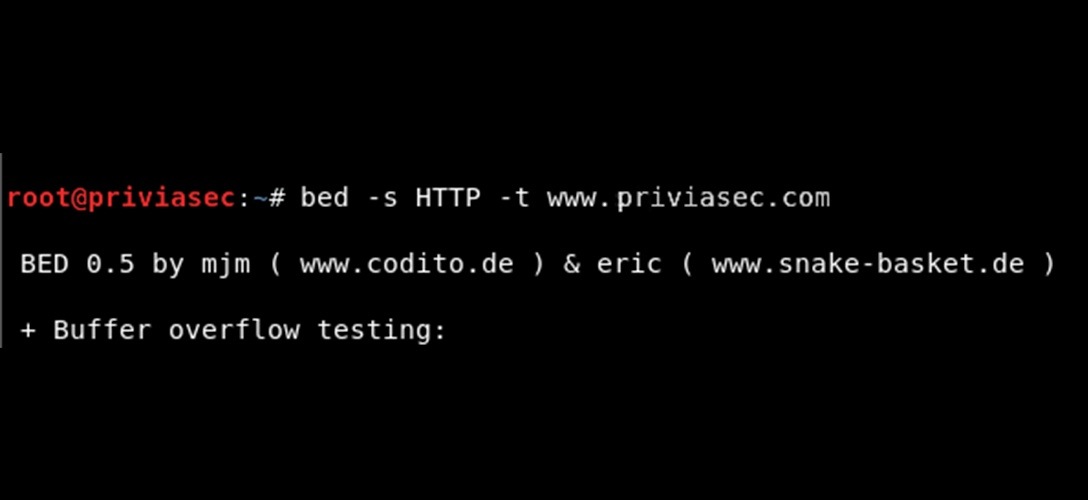
BED is a tool developed to detect weaknesses such as potential buffer overflows and format string bugs. The tool sends packets to services and checks whether the services are damaged after the sent packets.

root@priviasec:~# bed
./bed.pl -s <plugin> -t <target> -p <port> -o <timeout> [ depending on plugin ]

<plugin>   =  FTP/SMTP/POP/HTTP/IRC/IMAP/PJL/LPD/FINGER/SOCKS4/SOCKS5
<target>   =  Host to check (default: localhost)
<port>     =  Connection port (default: standard port)
<timeout>  =  Wait after each test (default: 2 seconds)
To obtain the required parameters for a plugin, use the command “./bed.pl -s <plugin>”.
-s is a mandatory parameter.

See also:
Privia Security GitHub: https://github.com/Privia-Security
You May Be Interested In These

We use a few cookies that are needed to make this website work, and they are always on. We would also like to set analytics cookies, to see which pages are useful; functional cookies, so that our live chat works; and advertising cookies, to measure our campaigns. We will not set any of those until you say yes, and you can change your mind at any time from the Cookie Settings link in the footer.
Choose the cookies you are happy for us to use. Strictly necessary cookies are always on; everything else is off until you turn it on.
These cookies keep the website working: they hold your security checks, your form submissions and the choice you make here. The site cannot run without them, so they are always on.
These let our live chat open and remember your conversation, and let the newsletter sign-up work. Switch them off and the chat window will not appear.
These tell us which pages are read and how people find us, so that we can improve the site. The reports are about groups of visitors, never about you personally.
These let us measure our advertising and show you our adverts on other websites, such as LinkedIn, Google and Meta. Switch them off and you will still see adverts, but they will be less relevant.


