

Explore our new Cybersecurity Terms Glossary, explained by our experts.

Explore our new Cybersecurity Terms Glossary, explained by our experts.
Cybersecurity Terms Glossary
The TCP/IP model describes the internet in four layers rather than seven. It is the stack actually implemented, and knowing where a control sits in it prevents a lot of wasted effort.
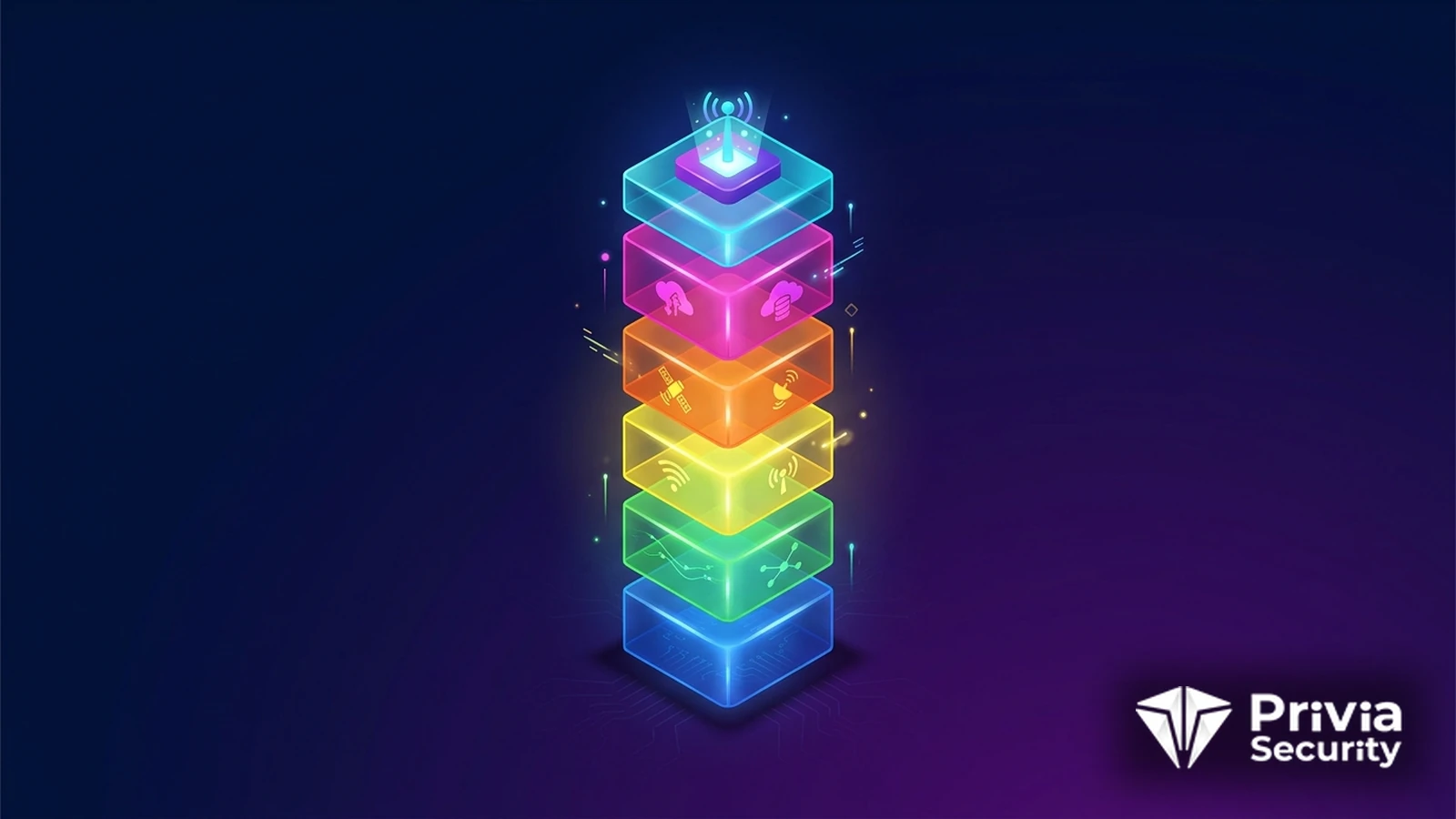
What Is the TCP/IP Model?
The TCP/IP model is the architecture the internet actually runs on. It emerged from the ARPANET work of the 1970s and was described in RFC 1122 in 1989, several years after the OSI model had been standardised as a blueprint for a protocol suite that never displaced it. Four layers rather than seven, and every one of them implemented in the operating system you are using to read this.
Link layer. Moving frames across a single physical or logical network: Ethernet, Wi-Fi, ARP, and the device drivers beneath them. Addressing here is by MAC address, and its scope is the local segment.
Internet layer. IP addressing and routing across networks, together with ICMP for diagnostics and control, and IPsec where it is deployed. This layer makes no promises: packets may be lost, duplicated, or delivered out of order.
Transport layer. TCP provides ordered, reliable, connection-oriented delivery through the three-way handshake, sequence numbers, and retransmission. UDP provides none of that and is therefore faster and simpler, which is why DNS, real-time media, and QUIC all use it. Ports live here.
Application layer. Everything above: HTTP, DNS, SMTP, SSH, TLS, and the applications themselves. The TCP/IP model deliberately collapses what OSI splits into session, presentation, and application, because in practice no separate layers exist.
Data passes down the stack, each layer adding its own header. An HTTP request becomes a TCP segment, which becomes an IP packet, which becomes an Ethernet frame. The receiving host unwraps in the opposite order. Every header is an opportunity and a risk: it is what a firewall inspects, and it is what an attacker manipulates.
This is also why tunnelling works and why it is difficult to control. A payload at one layer can contain a complete stack from another — DNS queries carrying exfiltrated data, HTTP carrying a SOCKS proxy, IP-in-IP, or any VPN protocol. Encapsulation has no inherent limit, which is why egress control by destination is more effective than egress control by protocol.
| Layer | Attacks | Controls |
|---|---|---|
| Application | Injection, phishing, API abuse, malware delivery | WAF, email authentication, secure development, proxy filtering |
| Transport | SYN floods, port scanning, TLS downgrade | SYN cookies, stateful filtering, modern cipher policy |
| Internet | IP spoofing, BGP hijacking, ICMP tunnelling | IPsec, ingress filtering, RPKI, ICMP policy |
| Link | ARP spoofing, VLAN hopping, rogue DHCP | 802.1X, DHCP snooping, dynamic ARP inspection, port security |
The value of this mapping is that it exposes the gaps. Most organisations have respectable controls at the application and transport layers and very little at the link layer, where an attacker with access to a network socket operates. It also prevents a common category error: proposing TLS as a remedy for ARP spoofing, or a firewall rule as a remedy for SQL injection.
Two developments blur the layers.
QUIC runs over UDP, implements reliability and congestion control that belong to the transport layer, and includes its own cryptographic handshake. One protocol occupying parts of three layers is deliberate, and it is why network security products designed around a clean transport boundary struggle with it.
Overlay networking in cloud and container environments means the link layer a workload sees is virtual, encapsulated inside a transport-layer tunnel such as VXLAN or Geneve that crosses a physical network you do not control. A Kubernetes pod’s view of its own network bears no relation to the underlying one, which changes what network controls can see and where they must be enforced — generally at the workload, which is the argument for microsegmentation.
Neither undermines the model as a way of thinking. It remains the fastest route to a correct diagnosis: establish whether the link is up, whether an address is assigned, whether a route exists, whether the port answers, and whether the application responds, in that order. The same discipline applied to an incident narrows the possibilities far faster than guessing. Our Penetration Test Services work through the stack in exactly this order.
TCP/IP has four layers and describes protocols that are actually implemented. OSI has seven and was designed as a blueprint for a suite that never achieved adoption. OSI splits the top into session, presentation, and application, which TCP/IP combines, and merges physical and data link into one link layer. OSI survives as shared vocabulary; TCP/IP is what runs.
It depends on the firewall. A packet filter works at the internet and transport layers, matching addresses, ports, and connection state. A next-generation firewall also inspects application-layer content to identify applications regardless of port. A web application firewall operates entirely at the application layer and understands request structure, which packet filters cannot.
Because any layer’s payload can contain a complete stack from another, which is how tunnelling works. DNS can carry exfiltrated data, HTTPS can carry a SOCKS proxy, and VPN protocols wrap entire networks. There is no inherent limit to nesting, so controlling egress by approved destination through a proxy is more effective than attempting to block protocols.
Workloads see a virtual link layer that is encapsulated inside tunnels such as VXLAN or Geneve running across infrastructure you do not control. The addresses a container sees bear no relation to the physical network. This moves enforcement towards the workload itself through security groups, network policies, and microsegmentation rather than towards network appliances.
You May Be Interested In These



We use a few cookies that are needed to make this website work, and they are always on. We would also like to set analytics cookies, to see which pages are useful; functional cookies, so that our live chat works; and advertising cookies, to measure our campaigns. We will not set any of those until you say yes, and you can change your mind at any time from the Cookie Settings link in the footer.
Choose the cookies you are happy for us to use. Strictly necessary cookies are always on; everything else is off until you turn it on.
These cookies keep the website working: they hold your security checks, your form submissions and the choice you make here. The site cannot run without them, so they are always on.
These let our live chat open and remember your conversation, and let the newsletter sign-up work. Switch them off and the chat window will not appear.
These tell us which pages are read and how people find us, so that we can improve the site. The reports are about groups of visitors, never about you personally.
These let us measure our advertising and show you our adverts on other websites, such as LinkedIn, Google and Meta. Switch them off and you will still see adverts, but they will be less relevant.


