

Explore our new Cybersecurity Terms Glossary, explained by our experts.

Explore our new Cybersecurity Terms Glossary, explained by our experts.

Red Team is a specialist cybersecurity service that has become increasingly preferred in recent years to identify and understand the risks an organisation may face in the event of a real cyber attack. Through this service, Red Team teams that view the organisation’s network through the eyes of a real cyber attacker focus on compromising the network using different techniques and analyses, and attempt every type of penetration. Controlled penetration tests conducted by cybersecurity experts can identify the organisation’s weakest points and deliver a real attack simulation. However, the Red Teaming service, which is conducted with a cyber attacker’s mindset, may fall short when it comes to defence and defending against attacks.
This is where the Blue Team Service comes in. Positioned on the defence side, the blue team consists of experienced specialists in incident response who guide personnel responsible for cyber defence. It provides feedback that leads and enables the IT cybersecurity teams responsible for protecting the organisation’s network to maintain a high level of security — that is, a high level of defence.
Typically, the two groups do not communicate with each other. The red team carries out its work with the aim of breaching the infrastructure, without informing their own technical departments. Of course, following a red team engagement, the red team’s movements, activities on the system, and findings need to be communicated to the blue team in a useful way. Because this does not always happen, purple team — the coordination side — has emerged.
The Red Team’s mission aims to follow the cyber kill chain. The Blue Team, meanwhile, has the capability to mitigate cyber attacks — in particular, to detect these attack attempts including lateral movement and privilege escalation events.
A successful Red Team must have a sophisticated adversarial mindset to access the organisation’s network and move through the environment without being detected. By its nature, it must use indirect, sometimes complex, sometimes highly specialised techniques. The ideal Red Team member must be both technical and creative. The team is made up of people who have the ability to exploit system weaknesses and human nature. It is also important for the red team to be familiar with threat actor tactics, techniques, and procedures (TTPs), as well as the attack tools and frameworks used by today’s cyber attackers.
Although the blue team is technically focused on defence, much of the work done as a Blue Team is proactive. Ideally, the Blue Team is responsible for identifying and neutralising risks and threats before they cause harm to the organisation. However, as attacks grow more complex, this makes the defensive side a challenging task even for skilled cybersecurity professionals. The blue team’s mission is detection and remediation.
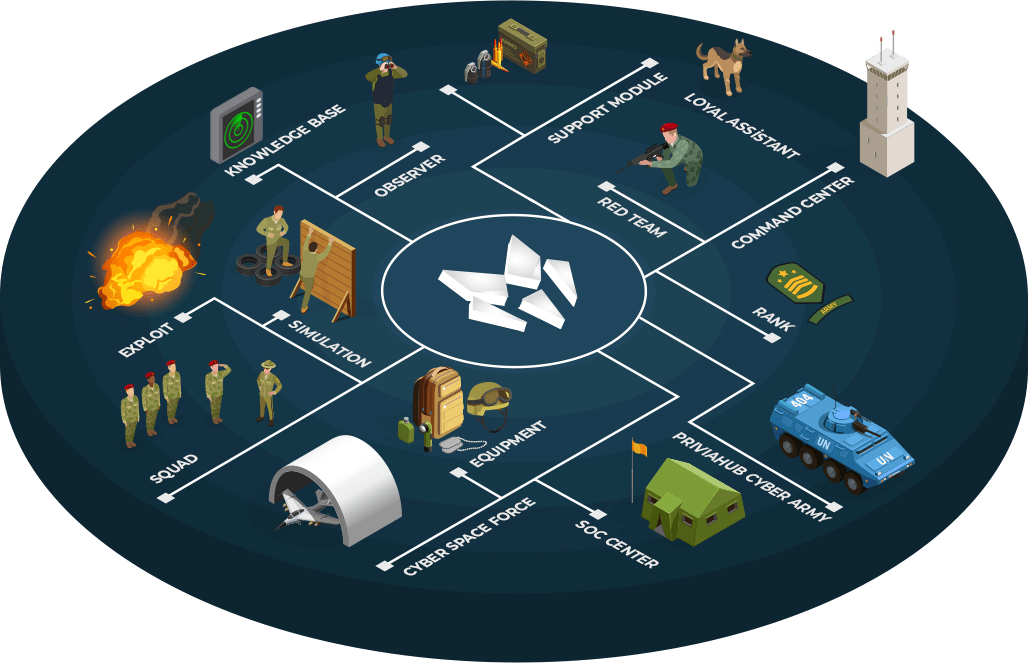
Red Team and Blue Team simulations and exercises play an important role in defending the organisation against a wide range of cyber attacks from today’s sophisticated adversaries. These exercises benefit organisations’ security significantly. The PriviaHub Cyber Range Platform can provide organisations with exercises, simulations, and a dedicated laboratory environment. With Cyber Range products, you can improve your teams in this area and create a training and simulation environment without causing any harm to your systems.
This plays an important role in auditing the organisation’s network.
For the Red Team and Blue Team services you need, you can contact our team to get a price quote and detailed information. At Privia Security, we are always here for you with our experts and exercise environments in Red Team and Blue Team.
You May Be Interested In These
We use a few cookies that are needed to make this website work, and they are always on. We would also like to set analytics cookies, to see which pages are useful; functional cookies, so that our live chat works; and advertising cookies, to measure our campaigns. We will not set any of those until you say yes, and you can change your mind at any time from the Cookie Settings link in the footer.
Choose the cookies you are happy for us to use. Strictly necessary cookies are always on; everything else is off until you turn it on.
These cookies keep the website working: they hold your security checks, your form submissions and the choice you make here. The site cannot run without them, so they are always on.
These let our live chat open and remember your conversation, and let the newsletter sign-up work. Switch them off and the chat window will not appear.
These tell us which pages are read and how people find us, so that we can improve the site. The reports are about groups of visitors, never about you personally.
These let us measure our advertising and show you our adverts on other websites, such as LinkedIn, Google and Meta. Switch them off and you will still see adverts, but they will be less relevant.


